
When to Save, What to Buy, and How to Win with Less
In VALORANT, not every round is about buying a Vandal, full shields, and every ability. Sometimes, the smartest decision is to spend less, work together, and prepare your team for the rounds that matter most.
A team that manages its economy properly can recover from consecutive losses, disrupt an opponent’s economy, and even steal rounds with nothing more than pistols and well-timed utility.
Two important strategies that every VALORANT player should understand are Eco Rounds and Half-Buy Rounds. Although both involve spending fewer credits, they have different purposes and require slightly different approaches.
In this guide, we’ll break down when to use each strategy, what to purchase, how to approach these rounds, and how to avoid common economy mistakes.
Before We Start: How Many Credits Do You Actually Need?
Before deciding whether to eco or half-buy, you need to understand how much a proper full buy costs.
The cost of a standard full buy
| Vandal / Phantom / Warden | 2,900 credits |
| Heavy Shields | 1,000 credits |
| Typical ability budget | 500–900 credits |
| Estimated total | 4,400–4,800 |
Costs vary according to your agent and the abilities you already have. The Warden joined the 2,900-credit rifle category in Patch 13.06.
A useful target is approximately 4,500–5,000 credits, giving you enough for a rifle, Heavy Shields, and the utility your agent needs.
Keep this figure in mind throughout the guide. Your goal during an eco or half-buy is often to preserve enough credits for your next proper buy.
Also, pay attention to the Min Next Round figure in the buy menu. It helps you calculate how many credits you’ll have next round based on your current purchases and guaranteed income.
Part 1: Eco Rounds
What Is an Eco Round?
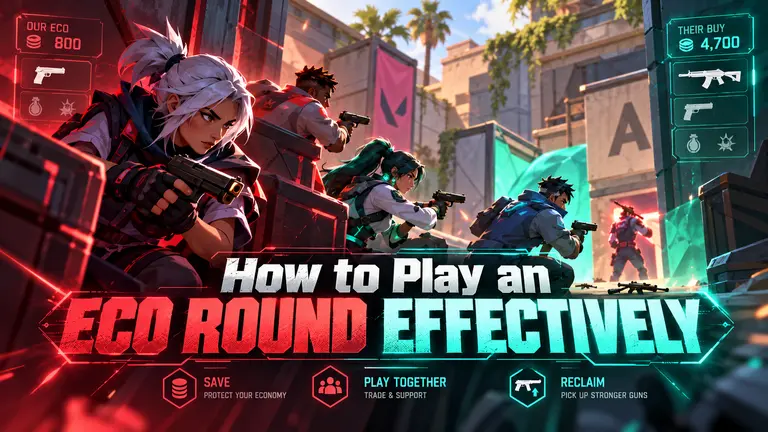
An Eco Round, short for Economy Round, is a round in which your team intentionally spends very few credits to save money for upcoming rounds.
Instead of purchasing expensive weapons and shields, you prioritize essential utility and inexpensive weapons—or sometimes purchase nothing at all.
For example, you might play with just a Classic and a few abilities. If your economy allows it, you could purchase a Sheriff or Light Shields, provided these purchases don’t interfere with your next full buy.
The main purpose is to protect your team’s future economy while attempting to inflict as much damage as possible on the enemy team.
An eco round doesn’t mean giving up. It means trying to win with limited resources without compromising the next round.
When Should You Play an Eco Round?
There are several situations in which playing an eco can help your team.
1. After losing the pistol round
If your team loses the first pistol round of either half, an eco in the second round is a common way to prepare for a stronger purchase in Round 3.
Depending on your team’s credits, spike plants, and strategy, you can occasionally force-buy instead. However, spending too much in Round 2 can leave your team poorly equipped for Round 3 as well.
2. After losing two consecutive rounds
Losing multiple rounds can leave your team with insufficient credits for rifles, shields, and abilities.
If your teammates cannot afford a coordinated full buy, playing an eco can help everyone recover financially and purchase together in the following round.
3. When an important round is approaching
Imagine you’re approaching a round in which you want your entire team to have rifles, full shields, and essential utility.
If purchasing weapons now would prevent that, consider an eco to protect your credits for the upcoming round.
This becomes especially important when preparing for a planned strategy that requires expensive utility or an Operator.
4. When your team’s economy is unbalanced
Sometimes, two players have enough credits for a full buy while the other three barely have enough to purchase a decent weapon.
If your team cannot afford to support a full buy across all five players, coordinating an eco can help reset everyone’s economy.
This is particularly useful after an unsuccessful force-buy or a round in which several teammates lost expensive weapons.
How to Play an Eco Round Effectively
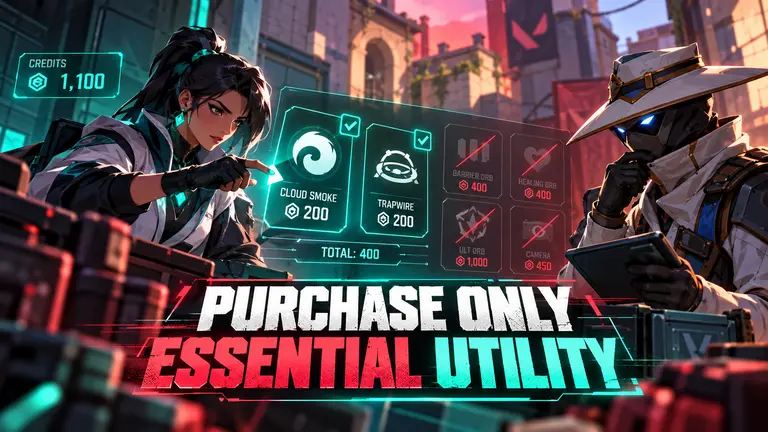
1. Purchase only essential utility
Your priority should be abilities that offer the greatest benefit to your team. A Controller might buy a smoke to block an important sightline, while a Sentinel might purchase a trap to provide information or delay an enemy push.
Avoid spending on unnecessary utility if it prevents your next full buy.
2. Choose your weapon according to your remaining credits
The Classic costs nothing and is perfectly acceptable for an eco. If you can afford an upgrade while preserving your next-round budget, consider a Sheriff or another inexpensive weapon.
Remember that a Sheriff plus Light Shields costs 1,200 credits. That’s a significant investment when you’re supposed to be saving.

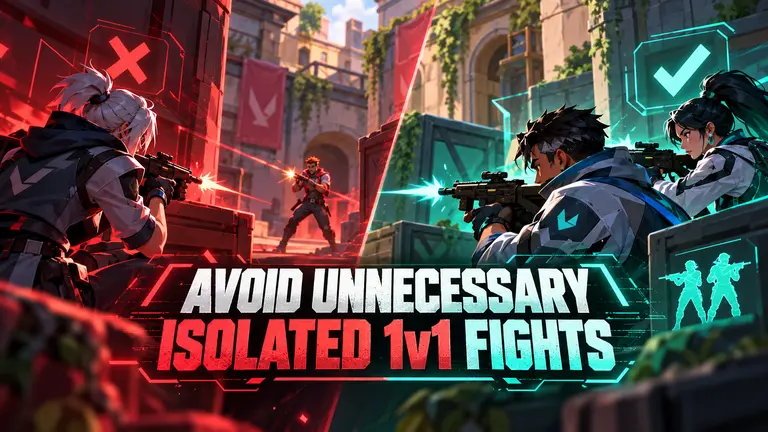
3. Avoid unnecessary isolated 1v1 fights
Most enemies will have stronger weapons and better shields, so challenging them individually puts you at a disadvantage.
Instead, play with a teammate so you can swing together or immediately trade each other’s kills. Even if one player dies, the second player may secure the trade and recover the enemy’s weapon.
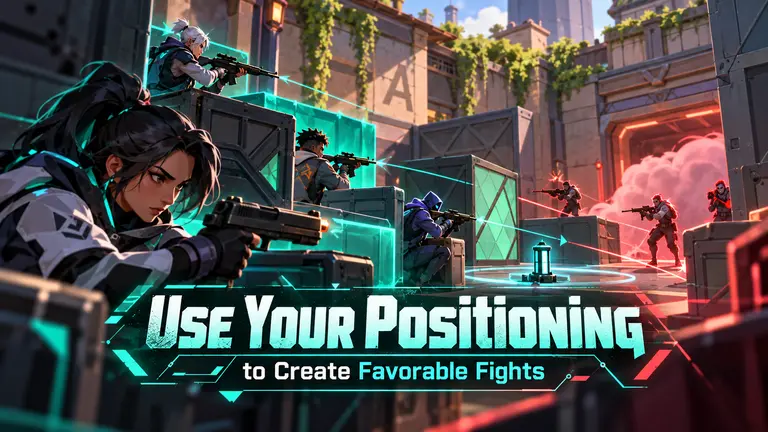
4. Use your positioning to create favorable fights
On defense, consider stacking multiple players on one site, holding close angles, or setting up crossfires.
Don’t give rifle players the long-range engagements they want. Force them to clear difficult corners and fight multiple players at close range.
On attack, move as a coordinated group and use your limited utility to isolate defenders. A well-timed site hit can be more effective than five individual players searching for kills.
5. Damage the enemy economy and recover weapons
Winning is always desirable, but even a lost eco can have value if you eliminate several opponents and force them to rebuy expensive equipment. If you kill an opponent carrying a Vandal or Phantom, try to recover that weapon when it’s safe to do so. A stolen rifle can turn a weak eco into a genuinely winnable round.

Extra tip: Plant the Spike whenever possible.
On attack, a successful spike plant awards every attacking player 300 credits—even if you subsequently lose the round. Each elimination also rewards the player who secured it with 200 credits.
The goal of an eco is to create opportunities while preserving your economy. Don’t throw away a realistic chance to win, but don’t spend your future full-buy credits on an unnecessarily expensive gamble either.
Part 2: Half-Buy Rounds
What Is a Half-Buy Round?
A half-buy is a middle ground between an eco and a full buy. Instead of spending almost nothing, you purchase a reasonably effective weapon, affordable shields, and useful abilities while saving enough credits for your next planned purchase.
Unlike a typical eco, where you’re mainly trying to preserve your economy and create opportunities, a half-buy allows you to challenge the enemy more aggressively and play for the round win without committing all your money.
For example, a Spectre, Light Shields, and essential utility can give you a competitive loadout at a considerably lower cost than a Vandal with Heavy Shields.
The important thing is that your half-buy should have a purpose. Simply buying whatever you can afford and leaving yourself with no credits next round is a force-buy, not a carefully planned half-buy.
When Should You Play a Half-Buy Round?
1. When you need to preserve credits for an upcoming full buy
Imagine your team wins both the pistol round and Round 2. Most surviving players will still have their Spectres or other weapons from the previous round.
Instead of replacing those weapons with expensive rifles, they can carry them into Round 3. Teammates who died can purchase cheaper replacement weapons so that everyone preserves money for Round 4.
This is commonly known as a bonus round, rather than a conventional half-buy, but the economic principle is similar: use affordable equipment now to protect your next full buy.
2. When a teammate has saved an Operator
Suppose your team’s Operator player survives the previous round with their weapon, but everyone else dies.
Since that player already has an expensive weapon, your team may be able to build a lower-cost strategy around them.
Depending on everyone’s credits, the remaining players can choose affordable weapons and utility, support the Operator, and preserve money for their next purchase.
However, this doesn’t mean everyone must half-buy simply because one player saved an Operator. If four players have enough credits for a proper full buy, purchasing rifles may still make more sense.
3. When your team’s economy is unbalanced
Sometimes, several teammates have enough credits to full-buy in both the current and following rounds, but you don’t have enough to purchase a rifle without damaging your future economy.
In this situation, a carefully planned half-buy can help you contribute to the current round without putting yourself even further behind.
If a teammate has excess credits, ask whether they can drop you a weapon. Coordinating purchases is generally more effective than letting one player struggle financially while everyone else has plenty of money.
4. When your team has multiple ultimates available
Imagine three teammates have their ultimates ready, and your team has enough credits to purchase a full loadout next round.
You might decide to play a half-buy and build your strategy around those ultimates.
For example, an ultimate that provides an extra weapon, helps secure a site, or creates a significant advantage in a team fight can make a cheaper loadout more competitive.
However, don’t use all your ultimates simply because you’re half-buying. Coordinate them so that you’re not wasting several powerful abilities on the same engagement.
How to Play a Half-Buy Round
Choose weapons that suit your planned engagements
Consider the Stinger or Spectre for close-range fights, a shotgun for holding tight angles, or a Bulldog if you have sufficient credits and expect longer engagements.
The weapon you purchase should complement your team’s strategy. There’s little value in purchasing a shotgun if you’re planning to challenge opponents across a large open area.
Coordinate your fights
Just like eco rounds, half-buys benefit from teammates playing together.
Use flashes, smokes, traps, and other utility to isolate opponents. Trading an inexpensive weapon for an enemy’s rifle can immediately change the balance of a round.
Apply controlled pressure
Unlike a conservative eco, your half-buy may provide enough firepower to challenge important areas of the map.
On attack, take space together and look for opportunities to secure the Spike plant. On defense, contest important positions with coordinated utility instead of unnecessarily giving up the entire map. You should still avoid repeatedly challenging expensive rifles in unfavorable fights.
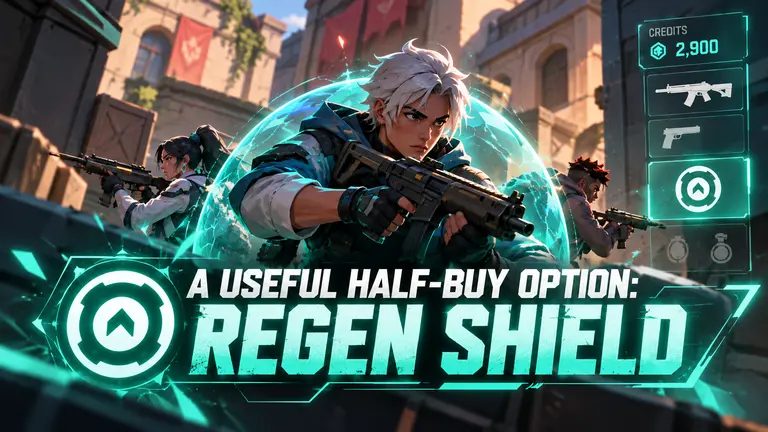
A Useful Half-Buy Option: Regen Shield
Regen Shield
Regen Shield initially provides 25 shield points and has an additional 50-point regeneration pool. After you take damage, it can regenerate your shield using that pool, provided you survive long enough for regeneration to begin.
It can be a useful alternative to Heavy Shields when you’re trying to limit your spending.
If you survive your half-buy with a usable Regen Shield, you can carry it into the following round rather than automatically purchasing new armor. This may leave you with enough money to upgrade your weapon to a Vandal or Phantom.
Remember, however, that Regen Shield doesn’t initially provide the same 50 shield points as Heavy Shields. Its value depends on surviving engagements and having enough regeneration capacity remaining.
One Important Economy Mistake: Saving Cheap Weapons After a Lost Round
There’s another important detail that applies to both eco and half-buy rounds: surviving a lost round doesn’t always mean you’re saving money.
VALORANT has a reduced credit reward for players who survive certain lost rounds. Under Riot’s economy rules, you receive only 1,000 credits if you’re an attacker who survives a lost round without planting the Spike, or a defender who survives after the enemy Spike detonates.
Compare that with the usual loss bonuses.
| Consecutive losses | Normal loss income | Income when the survival penalty applies |
| First loss | 1,900 | 1,000 |
| Second loss | 2,400 | 1,000 |
| Third or later | 2,900 | 1,000 |
If you’re carrying nothing more than a Classic or another inexpensive weapon, saving it at the expense of a substantial loss bonus can leave you worse off financially.
For instance, on defense, if the Spike is about to explode and you have no valuable weapon to preserve, dying to the explosion may be economically preferable to surviving with a cheap pistol.
That doesn’t mean you should automatically run toward an enemy and die. They receive credits and potentially an ultimate point for eliminating you. You should consider whether you can still win the round, recover a better weapon, or preserve equipment worth more than the income you’d lose.
When should you save your weapon?
If you’ve recovered a Vandal, Phantom, Operator, or another valuable weapon during an eco, preserving it can save you considerably more than the reduced credit reward costs you.
The same principle can apply to an affordable weapon if keeping it will materially improve your next-round purchase.
A Practical Example: Planning Your Next Buy
Suppose you have 4,000 credits, your team has lost two consecutive rounds, and you expect to receive another 2,900 credits if you lose the current round.
You want to have at least 4,600 credits next round for a full buy.
Your spending calculation
| Current credits | 4,000 |
| Expected loss income | +2,900 |
| Next-round target | −4,600 |
| Maximum you can spend now | 2,300 |
This calculation assumes you receive the normal loss bonus, without additional income from kills or planting the Spike.
You could use that 2,300-credit budget for a Spectre, Light Shields, and 300 credits of essential utility. Even if you lose, your next full buy remains affordable.
This is the mindset you should develop: decide what you want to buy next round before spending your credits in the current one.
Final Thoughts: Your Economy Is a Team Resource
Eco and half-buy rounds aren’t simply about purchasing cheaper weapons. They’re about understanding how your decisions now affect your team’s ability to compete later.
During an eco, prioritize your next full buy while creating opportunities through coordinated fights, favorable positioning, spike plants, and recovered weapons.
During a half-buy, spend enough to give your team a realistic chance of winning, but establish a clear spending limit so that your upcoming full buy remains possible.
Always communicate your buying decisions. If three teammates are saving while the other two spend everything, you can end up with several consecutive rounds in which your team cannot purchase together.
Finally, remember that economy management is situational. If you’re playing the last round of a half, there’s no reason to preserve credits for the next round because the economy resets after switching sides. Other circumstances may also justify an aggressive force-buy.
The objective isn’t to save as many credits as possible. It’s to make sure your team has the equipment it needs in the rounds where that investment matters.