VALORANT Pistol-Round Economy Strategy: How to Play Rounds 2, 3 and 4
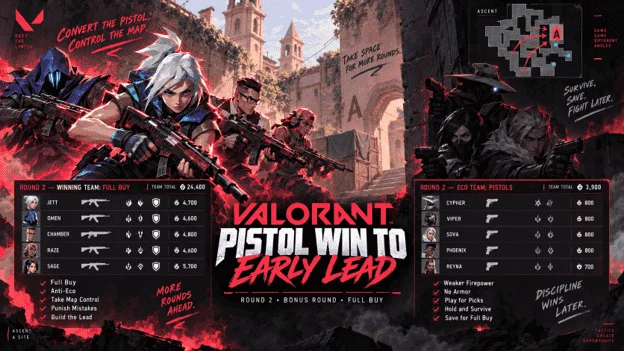
Winning the pistol round in VALORANT is important, but the real advantage does not come from
the pistol round alone.
It comes from what you do after winning it.
The first three or four rounds of a half are connected by VALORANT’s economy system. A good
team can turn one pistol-round victory into a 2-0 lead, create a dangerous bonus round, and
potentially build a 3-0 start. A team that manages its economy poorly can win the pistol and
immediately throw away that advantage.
The same applies to the team that loses the pistol. Round 2 is usually difficult, but the objective
is not always simply to somehow win that round. Sometimes the smarter strategy is to damage
the enemy economy, preserve your own credits, and prepare a much stronger Round 3.
This guide breaks down both sides of the situation and explains how you should approach
Rounds 2, 3 and 4 after a pistol round.
Why the Pistol Round Changes the Next Few Rounds
VALORANT gives each player 800 credits at the beginning of a half.
Once the pistol round finishes, the economy begins to separate.
A round victory awards 3,000 credits, while the first consecutive loss awards 1,900 credits.
The loss bonus then increases to 2,400 after a second consecutive loss and 2,900 after three or
more consecutive losses. Kills also provide 200 credits, while a Spike plant gives the attacking
team an additional 300 credits per player.
That difference creates the basic Round-2 situation:
Pistol winner: stronger weapons, armor and utility.
Pistol loser: weaker weapons or an economic decision between saving, partially investing, or
occasionally forcing.
This is why winning the pistol should normally create a strong advantage in Round 2.
And professional data shows how powerful that advantage can be.
An analysis covering 126 series, 288 maps and roughly 44,000 kill events from VCT 2026
Stage 1 across Pacific, EMEA and Americas found that the team with the economic
advantage after winning pistol won Round 2 roughly 80% of the time on average. In that
dataset, LEVIATÁN, Gentle Mates and DRX recorded 100% second-round conversion rates,
with LEVIATÁN maintaining that record across 25 opportunities.
A separate large-scale analysis of approximately 2.2 million professional VALORANT rounds
found that eco teams upset better-equipped opponents around 19% of the time in normal eco
situations, but that number fell to only 10.7% in anti-eco rounds directly following pistol
rounds.
Different datasets classify economy situations slightly differently, so there is no single universal
conversion percentage. However, they all tell us the same thing:
Winning pistol gives you a huge Round-2 advantage — but only if you actually use your
economy correctly.
Part 1: You Won the Pistol Round — What
Should You Do?
Your main objective after winning pistol is simple:
Convert the economic advantage into a 2-0 lead
One of the biggest mistakes players make in ranked is winning pistol and then keeping their
Ghosts or Classics because they want to save money for a rifle in Round 3.
That usually wastes the entire advantage you just earned.
Your opponents are probably entering Round 2 with pistols and limited utility. You have more
money. Use it.
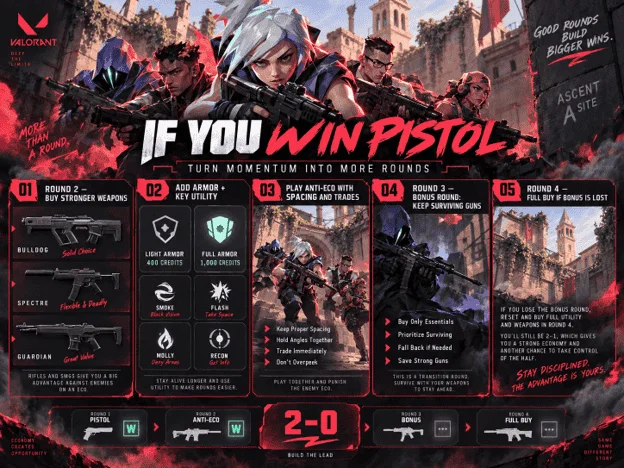
Buy After Winning Pistol
Your team should normally invest enough money to create a clear weapon advantage.
Depending on your credits, Agent and planned strategy, strong Round-2 weapons can include:
● Bulldog
● Spectre
● Guardian
● Outlaw
● Marshal
● Stinger in appropriate situations
● Occasionally a Vandal or Phantom
Armor and important Agent utility should also be included whenever your economy allows it.
VCT 2026 Stage 1 data provide an interesting professional example. In the analyzed second
rounds, the Bulldog was the most commonly purchased primary weapon, followed by the
Spectre and Guardian. The data also showed that the exact weapon choice mattered less than
maintaining a balanced overall buy with useful weapons, armor and utility.
That is an important lesson.
Your objective is not necessarily to buy the most expensive weapon possible.
Your objective is to create the largest practical advantage over the enemy’s weaker
economy.
Should You Buy a Vandal or Phantom in Round 2?
Sometimes.
Imagine your Duelist wins pistol with multiple kills and finishes the round with enough credits to
purchase a Vandal or Phantom while still maintaining reasonable armor and utility.
That can create a huge range and damage advantage against Classics, Ghosts or other pistols.
A rifle can completely dominate long-range fights against an eco team.
However, this should not automatically become your Round-2 strategy.
There is also risk.
If you take an isolated fight and die, the enemy can pick up your Vandal and suddenly their eco
round becomes much more dangerous.
That is why weapons such as the Bulldog, Spectre, Guardian and Outlaw are extremely
common anti-eco options. They are significantly stronger than pistols without requiring the same
investment as a traditional full rifle setup.
Think of your buy as a team investment, not an individual flex.
Your Gun Advantage Only Matters If You
Protect It
Imagine you have a Bulldog and Heavy Shields while your opponent has a Classic.
You should win that fight.
But that does not mean you should run into a tight corner where the Classic can right-click you
at point-blank range.
This is where many anti-eco rounds are thrown.
The enemy understands that their weapons are weaker, so they may try to:
● Stack five players on one site
● Hide in close corners
● Rush together
● Use Shortys or Frenzies at close range
● Buy Sheriffs and search for headshots
● Set traps around a dropped rifle
● Force isolated 1v1 fights
Do not give them the type of fight they want.
Use your superior range.
Use utility to clear dangerous corners.
Move with teammates.
And most importantly:
Trade each other.
The VCT 2026 Stage 1 analysis found that when the economically advantaged team lost first
blood but successfully traded that death, it still won around 90% of those rounds in the
analyzed sample. When no trade occurred, the win rate dropped to around 68%.
That is a massive difference.
Your gun advantage becomes much more powerful when the enemy cannot collect a free
weapon after getting one kill.
Round 3: The Bonus Round
Now imagine everything went according to plan.
You won pistol.
You purchased stronger weapons in Round 2.
You converted the anti-eco.
The score is now 2-0.
This creates one of the most important economy situations in VALORANT:
The Bonus Round.
The team that lost the first two rounds usually saved enough credits during Round 2 to enter
Round 3 with rifles, shields and utility.
They are finally approaching full strength.
Your team, however, may still have Bulldogs, Spectres, Guardians, Outlaws or other weapons
surviving from Round 2.
This is where many players make another economy mistake.
They sell or abandon perfectly usable weapons and spend everything on Vandals.
Usually, you do not need to do that.
Why Is It Called a Bonus Round?
Because you already achieved your main objective.
You converted pistol into a 2-0 lead.
Instead of spending your entire bank trying to match the enemy’s Round-3 full buy, you can
carry your Round-2 weapons forward and challenge their rifles with a cheaper loadout.
If you lose, your economy should still allow a strong purchase in Round 4.
But if you win?
The economic damage to your opponent can be enormous.
They just spent thousands of credits on their first major rifle round and lost it.
Your cheaper weapons have now beaten their full buy.
You can potentially collect their rifles, keep your bank healthy and force them back toward
another weak economic round.
That is why a bonus-round victory is so valuable.
Do Not Treat the Bonus Round Like a Throwaway Round
Calling it a “bonus” does not mean:
“We don’t care if we lose.”
You should still try to win.
The difference is that you are trying to win without destroying your future economy.
You can improve your chances by designing the round around your weapons.
If you have Spectres, create closer-range fights.
If you have Bulldogs or Guardians, use medium and long-range engagements.
If you have an Outlaw, look for opportunities against players using Light Shields.
Use ultimates intelligently if winning the round could destroy the enemy economy.
And play for trades.
Even if you eventually lose the round, killing three or four enemy players can still create serious
economic damage.
A 2-0 bonus round where you kill four players before losing can be much more valuable than a
clean 2-0 loss where all five enemy rifles survive.
What If Only Two or Three Players Survive
Round 2?
This is where team economy matters.
Imagine only two players survive your Round-2 anti-eco.
Those players keep their weapons.
The other three players now need to purchase again.
That does not automatically mean everyone needs Vandals.
Look at the entire team’s credits.
You can rebuy weapons that maintain a competitive Round-3 setup while still protecting the
team’s ability to buy properly in Round 4.
Players with large banks may sometimes upgrade or buy for teammates.
Players with surviving weapons should usually keep them.
The objective is to keep your economy synchronized.
Five players making one coordinated economy decision is far stronger than two players full
buying while three players are broke.
Part 2: You Lost the Pistol Round — What
Should You Do?
Now let’s look at the opposite side.
You lost Round 1.
The first thing you need to understand is:
Round 2 is not supposed to be an equal fight.
The enemy earned an economic advantage by winning pistol.
Trying to completely match their investment when you cannot afford it can damage your
economy for multiple rounds.
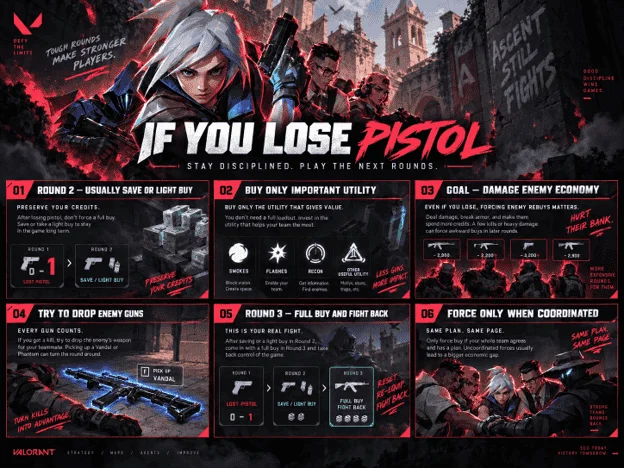
The standard approach is therefore to save or make a very limited investment while
preparing for your stronger Round-3 buy.
But there are important exceptions.
The Standard Round-2 Approach After Losing Pistol
If you lost pistol and did not generate enough additional money to justify a coordinated force,
avoid randomly buying expensive weapons.
You should usually protect enough money to ensure a strong Round-3 purchase.
This does not necessarily mean every player must literally spend zero credits.
Certain important utility can still be worth purchasing.
For example, a Controller may need essential smokes if your team has a realistic plan for the
round.
A player may purchase a cheap pistol if the buy does not damage the next-round rifle purchase.
However, do not spend credits on abilities simply because they are available.
Ask:
Does this purchase significantly improve our chances this round without destroying my
Round-3 buy?
If the answer is no, save the credits.
The easiest way to check this in-game is to watch the minimum next round value in the buy
menu.
Your Real Objective During the Eco
Of course you would love to win the round.
But against a properly equipped anti-eco team, winning is statistically difficult.
Your secondary objective is therefore:
Damage their economy.
Every enemy you kill can remove:
● Their weapon
● Their armor investment
● Their utility investment
● Their ability to carry that gun into the bonus round
If you kill someone holding a Bulldog, Spectre or even a Vandal and recover it, the value
becomes even greater.
This means an eco round where you lose but kill four opponents can still be extremely
successful economically.
Your opponents must rebuy those weapons before the bonus round.
That makes their Round-3 economy weaker.
Do Not Take Five Separate 1v1s on an Eco
If the enemy has better weapons, isolated fights usually favor them.
Instead, eco teams should try to create situations where several players can attack one
opponent.
Stacking an area, creating crossfires, rushing through one location together or setting up close
range ambushes can increase your chances of stealing a weapon.
Your first kill is especially important.
Once an enemy drops a stronger gun, your entire round changes.
The VCT 2026 Stage 1 analysis found that in every observed eco comeback in its sample, at
least one player produced a multi-kill. That emphasizes why anti-eco teams must trade properly
— and why eco teams should actively look for opportunities to turn one kill into a weapon
upgrade and then another kill.
When Should You Force After Losing Pistol?
This is where the strategy becomes more complicated.
Saving after a pistol loss is a strong default rule.
It is not an absolute rule.
There are situations where a coordinated force can make sense.
For example:
You planted the Spike before losing pistol
The plant gives the attacking team extra credits, making your Round-2 economy considerably
stronger than a normal pistol loss.
Your team secured several pistol-round kills
Kills provide additional credits and may also have damaged the opponent’s ability to make a
perfect Round-2 purchase.
The scoreline makes waiting dangerous
If you lose the second-half pistol while already far behind, allowing the opponent to reach 10, 11
or 12 rounds uncontested may be worse than accepting the economic risk of a force.
Your team has a practiced force-buy strategy
Five players deliberately buying around a specific execute is completely different from two
players randomly buying Stingers while three teammates save.
Team synchronization matters.
Interestingly, a recent analysis using VCT and VCL match data from 2023 onward argued that
second-half pistol-loss forces may be strategically undervalued in some score situations.
However, the author also noted that VCT-only sample sizes for some scorelines were small, so
this should be treated as situational evidence rather than a universal rule.
The practical rule for ranked is simpler:
If you force, force together.
Do not create a half-save, half-force team by accident.
What Happens If You Win Round 2 After Losing Pistol?
This is one of the best situations you can create.
You lost pistol.
The opponent invested heavily into their anti-eco.
Your team entered with a weaker buy.
And somehow you won.
Now the economy can completely flip.
You may recover their weapons, preserve some of your credits and force them to rebuy
everything they just lost.
Instead of entering Round 3 as the expected full-buy team against a bonus, you may now have
recovered rifles and a healthy economy while your opponent has been economically damaged.
At this point, do not immediately throw that advantage away.
Keep the recovered weapons.
Build the strongest coordinated Round-3 purchase your economy allows.
And try to convert the economic swing.
Should You Save a Classic at the End of aLost Eco?
Usually, no.
This is another small economy detail that can matter.
VALORANT has special rules designed to prevent players from simply hiding during lost rounds.
Attackers who lose a round while surviving without planting the Spike can receive only 1,000
credits, and defenders who survive after losing because the Spike detonated can also receive
only 1,000. Riot introduced these rules specifically to create a meaningful decision between
saving equipment and accepting the loss.
So imagine you are defending with only a Classic.
The Spike is about to explode.
There is no realistic chance to defuse.
Saving that Classic provides almost no value.
Allowing the Spike to eliminate you can be economically better than surviving with a worthless
pistol and receiving the reduced survivor income.
Professional players regularly make these small economy calculations.
However, the important word is value.
If you are holding a recovered Vandal, Operator or another expensive weapon, saving can
obviously be worth much more than the additional loss credits.
Do not die simply because someone told you that dying is always better.
Evaluate what you are carrying.
Real VCT Evidence: How Important Is Round-2 Conversion?
The professional scene gives us some extreme examples of how seriously teams treat these
rounds.
At VALORANT Champions 2025, attack-side teams on Abyss and Haven recorded 100%
second-round conversion rates after winning pistol in the tournament data analyzed by
THESPIKE.
On defense, second-round conversion reached 90% on Lotus and 90.91% on Bind.
The larger VCT 2026 Stage 1 dataset found an average Round-2 win rate of roughly 80% for
the economically advantaged pistol winner, while several teams managed perfect conversion
rates within the sample.
And the much larger professional-economy analysis found another interesting number:
Winning pistol was associated with winning the overall map approximately 63.5% of the time
across its dataset.
That does not mean pistol automatically decides a map.
It means economic advantages can compound.
Pistol win.
Anti-eco conversion.
Bonus-round damage.
Stronger Round 4.
One successful round can influence several rounds after it.
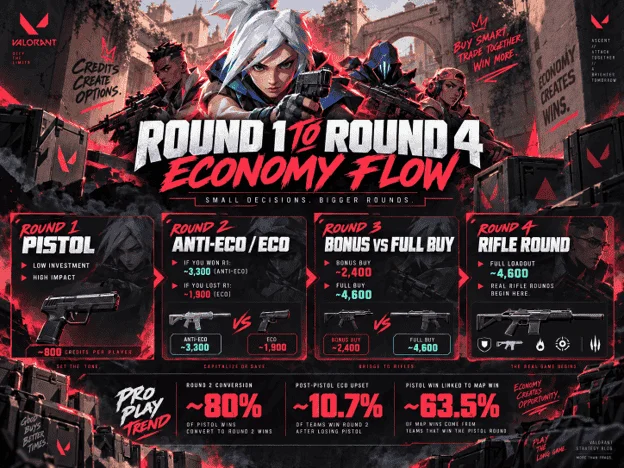
The Simple Round 1–4 Blueprint
Here is the easiest way to remember the strategy.
If You Win Pistol
Round 1 — Pistol Win
You gain the economic advantage.
Round 2 — Anti-Eco
Buy stronger weapons, armor and useful utility. Use your range advantage, play together and
convert the round.
Round 3 — Bonus
Carry surviving Round-2 weapons forward instead of unnecessarily replacing everything with
rifles. Try to upset the opponent’s first full buy or at minimum kill multiple players.
Round 4
If you lost the bonus while protecting your economy, you should now be ready for a proper rifle
versus-rifle round.
If You Lose Pistol
Round 1 — Pistol Loss
You begin Round 2 economically disadvantaged.
Round 2 — Eco / Save / Situational Force
Normally preserve enough credits for Round 3. Buy only strategically valuable utility or cheap
upgrades that do not destroy your future purchase.
Your goal is to win if possible, but at minimum kill enemy players and remove expensive
weapons.
Round 3 — Your First Strong Buy
Because you protected your economy, you should now be able to challenge the opponent’s
bonus weapons with rifles, armor and utility.
This is the round you are expected to have the equipment advantage.
Round 4
If you win Round 3 cleanly, you can begin attacking the opponent’s economy and potentially
take control of the half.

Final Takeaway
The biggest lesson is simple:
Do not think about VALORANT economy one round at a time.
Think two or three rounds ahead.
When you win pistol, spend enough money to exploit your advantage instead of being afraid to
buy.
When you lose pistol, do not panic and randomly force simply because the enemy is ahead.
When you enter a bonus round, understand that preserving economy while damaging the
opponent can be almost as important as winning.
And regardless of your economy:
Buy together, fight together and trade together.
A coordinated team with a clear economy plan will consistently get more value from its credits
than five players making individual buying decisions.
Good aim can win a duel.
Good economy management can give you the better weapon before the duel even begins.